
The Resonant Mind
How Vibration drives Focus & Creative Flow

“Our senses enable us to perceive only a minute portion of the outside world.”
— Nikola Tesla
There is a hidden room within all creators. A space where ideas take shape, emotions become form, and imagination feels most alive.
For some, it is quiet. For others, it is a whirlpool of noise and distraction.
But what if there were a way to tune that chamber not just mentally, but physically?
Not merely by cajoling your thoughts into discipline, but by shaping the environment itself so the mind falls into focus?
This is where vibration enters the creative process.
Frequencies become tools for shaping attention, sparking creative flow, and anchoring the wandering mind.
For decades, researchers have studied how vibration interacts with human physiology, mostly in therapeutic or sports contexts.
But when we look carefully at these findings through the lens of writing, video, and music creation, a fascinating possibility emerges. Mechanical vibration can influence cognitive states relevant to creative output.
This article explores that idea in depth, synthesizing research on vibration and cognition, explaining core mechanisms, and arguing for a paradigm where frequency becomes part of a creator’s toolkit.
“All knowledge, when it penetrates beyond the surface, is a form of resonance.”
— Johann Wolfgang von Goethe

The Physics Beneath Thought
At its core, vibration is the rhythmic motion of matter. In the physical world, it is measured in Hertz (Hz), or cycles per second. A tuning fork vibrating at 440 Hz produces the pitch A above middle C. A platform vibrating at 30 Hz moves the structure at 30 cycles per second.
When mechanical vibration interacts with the human body, several things happen.
Structures resonate, meaning they begin to oscillate together rather than independently.
Mechanoreceptors activate. These are specialized sensory cells in the skin and musculoskeletal system that respond to rhythmical motion.
Neural systems respond. Vibration can influence patterns of neural activity, particularly in brain regions related to sensorimotor integration and attention.
These effects are not theoretical. They are measurable, and they form the backbone of several scientific studies that connect vibration to cognitive enhancement.
A growing body of research suggests that mechanical vibration can have measurable effects on attention, executive function, and cognitive performance. These are critical inputs to creativity and focus.
“The faculty of voluntarily bringing back a wandering attention, over and over again, is the very root of judgment, character, and will.” — William James

When the Body Thinks First
Many studies investigate what is called whole body vibration, often abbreviated as WBV. In these studies, a platform vibrates at a specific frequency and the body receives the oscillations through physical contact.
Although this research often occurs in medical or exercise science contexts, its relevance to mental performance is clear.
A 2025 meta analysis found that WBV is associated with meaningful improvements in overall cognitive function, including attention and executive function. This suggests that vibration, when applied in controlled doses, can influence brain processes related to focus and decision making.
Additional systematic reviews report that mild exposure to vibration in the 20 to 70 Hz range appears to stimulate neurocognitive responses, although standardized protocols are still emerging.
A classic PLOS ONE study showed that just two minutes of passive WBV at approximately 30 Hz produced positive short term effects on attention and inhibition performance in healthy young adults. This is notable because it illustrates how short, non intense vibration can directly interact with executive function, the part of cognition that governs focus.
Other research has shown that WBV can improve selective attention and inhibition in sitting postures, indicating that posture and context matter for cognitive effects.
Even if these studies were designed for clinical or therapeutic outcomes, they point to a broader conclusion. Mechanical vibration can modulate cognitive processes that matter for creativity and focused work.
“The mind is not confined to the skull, but emerges from the entire field of interaction.”
— Maurice Merleau-Ponty
Why 40 Hertz Keeps Appearing
Beyond whole body effects, certain frequencies have been studied for their relationship to neural oscillations, which are rhythmic patterns of brain activity.
One especially compelling frequency is 40 Hz.
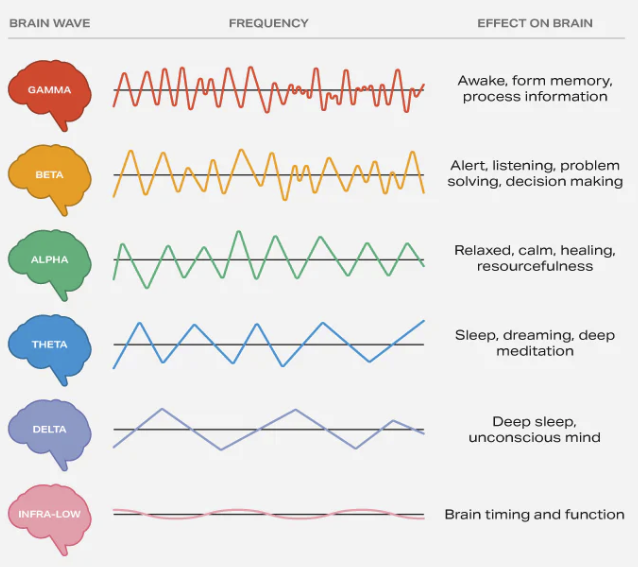
Gamma: The Rhythm of Coherence
In neuroscience, 40 Hz sits in the gamma range, roughly 30 to 70 Hz. Gamma rhythms are correlated with active cognition, working memory, attention, and perceptual binding.
Research on sensory stimulation at approximately 40 Hz shows several important effects.
Audiovisual and multisensory stimulation at 40 Hz can induce gamma oscillations in cortical regions and is being explored for cognitive enhancement in clinical contexts.
Emerging studies suggest that vibrotactile stimulation at approximately 40 Hz can increase neural activity in somatosensory and motor cortices. In animal models, such stimulation reduced pathological markers and enhanced neural function.
Investigations into 40 Hz transcranial vibration suggest that this frequency can enhance spontaneous brain activity and synchronize neural dynamics in ways relevant to cognition.
Most of the gamma stimulation literature exists in clinical or neuroscientific domains. However, the mechanistic insight remains relevant. External rhythmic stimulation can influence internal neural rhythms associated with attention, coherence, and task engagement.
“Order is not imposed from without. It arises when the conditions are right.”
— Henri Poincaré
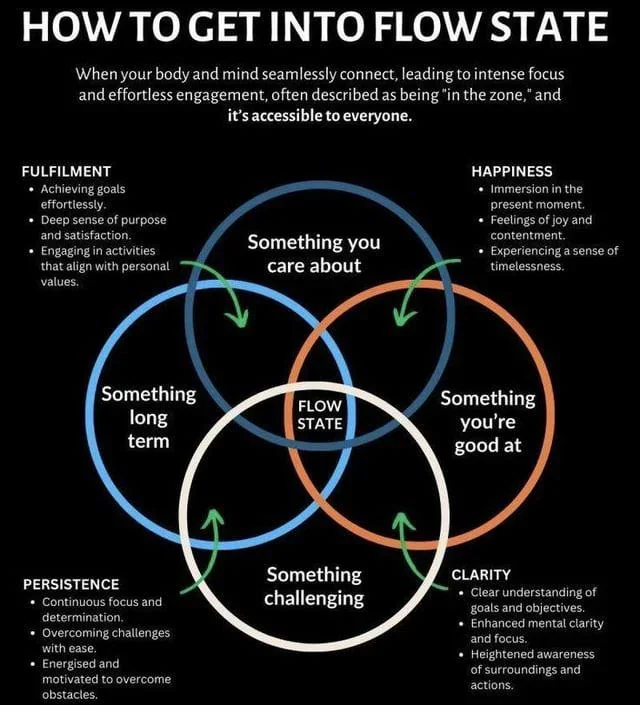
From Physiology to Flow
Now we can connect the dots from research to real creative work, including writing, video production, and music composition.
Here is how vibration might support creative productivity.
Anchoring Attention
Research on WBV indicates that properly dosed vibration can improve selective attention and inhibition. In writing or composing, these functions help you stay on task longer, resist distraction, and maintain coherence in thought.
A brief bout of vibration at approximately 30 Hz or 40 Hz could prime your focus systems before you begin creative work. This is roughly analogous to a ritual that transitions the brain from rest or random thought into structured engagement with a task.
Reducing Cognitive Noise
Creativity is a balance between free association and structured thought. Too much mental noise and ideas stay disconnected. Too much structure and imagination stalls.
By modulating the sensory environment through vibration, it may be possible to lower irrelevant sensory input and allow the nervous system to prioritize task relevant processing. Research suggests vibration can enhance neural synchrony, which could translate to fewer intrusions during a creative flow session.
The Body as a Stabilizer
Vibration stimulates mechanoreceptors and engages the somatosensory cortex. This can produce a feeling of groundedness, a physical form of coherence that may support sustained focus and reduce restless energy.
Think of it as a bridge between body and mind. When the body perceives organized rhythm, the mind can entrain to that rhythm for more stable thought.
“Stability is not the absence of motion, but the balance of forces.”
— Ernst Mach
Creative Practice Across Mediums
Humans are highly responsive to context. A workspace with tuned vibration becomes a signifier, similar to a meditation cushion or ritual bell, that signals it is time to create. Over time, this environmental cue can elicit conditioned focus responses.
Whether drafting a chapter, sketching a score, or storyboarding a scene, vibration, when used thoughtfully, could serve as an environmental catalyst for creative breakthroughs.
Writing
Begin a session with two to five minutes of gentle vibration at approximately 30 to 40 Hz. This aligns with research showing improved executive function after short exposure and may help shift the brain into focused mode before writing.
Music Composition
Use vibration rhythmically during improvisation or composition sessions. Because music intrinsically involves rhythm and frequency, synchronizing the creative process with physical vibration may deepen engagement with tonal and structural patterns.
Video and Visual Storytelling
Vibration may serve as a sensorial framing device, helping sustain attention during long sessions of editing or narrative structuring, particularly when stuck in loops of indecision or distraction.
What Science Has Not Claimed
Science has not definitively proven a frequency of creativity. There is no peer reviewed study that states 30 Hz will make someone write better than 27 Hz.
What the evidence does suggest is the following.
Vibration can influence attention and executive control in measurable ways.
Certain frequencies, such as approximately 30 Hz and 40 Hz, interact with neural and sensory systems relevant to cognition.
Importantly, these studies do not disprove what many creators experience subjectively. Vibration often appears to shift mental state in ways that are difficult to articulate but consistently reported.
Vibration is not a magic solution. It is a physical mechanism that can interact with attention systems, sensory processing, and environmental context in ways that matter for focus and creative output.
By embracing vibration as part of a creative ritual, grounded in both scientific insight and direct experience, creators are not chasing mysticism. They are tuning their environment to better support the complex mental harmonies that produce writing, music, and visual art.
Continued experimentation, observation, and refinement remain essential. In the end, lived experience becomes the most relevant data set.
“What we observe is not nature itself, but nature exposed to our method of questioning.”
— Werner Heisenberg