
Strange Matter
Pressure, Pulsars, and the Question of What Reality Becomes When It Breaks
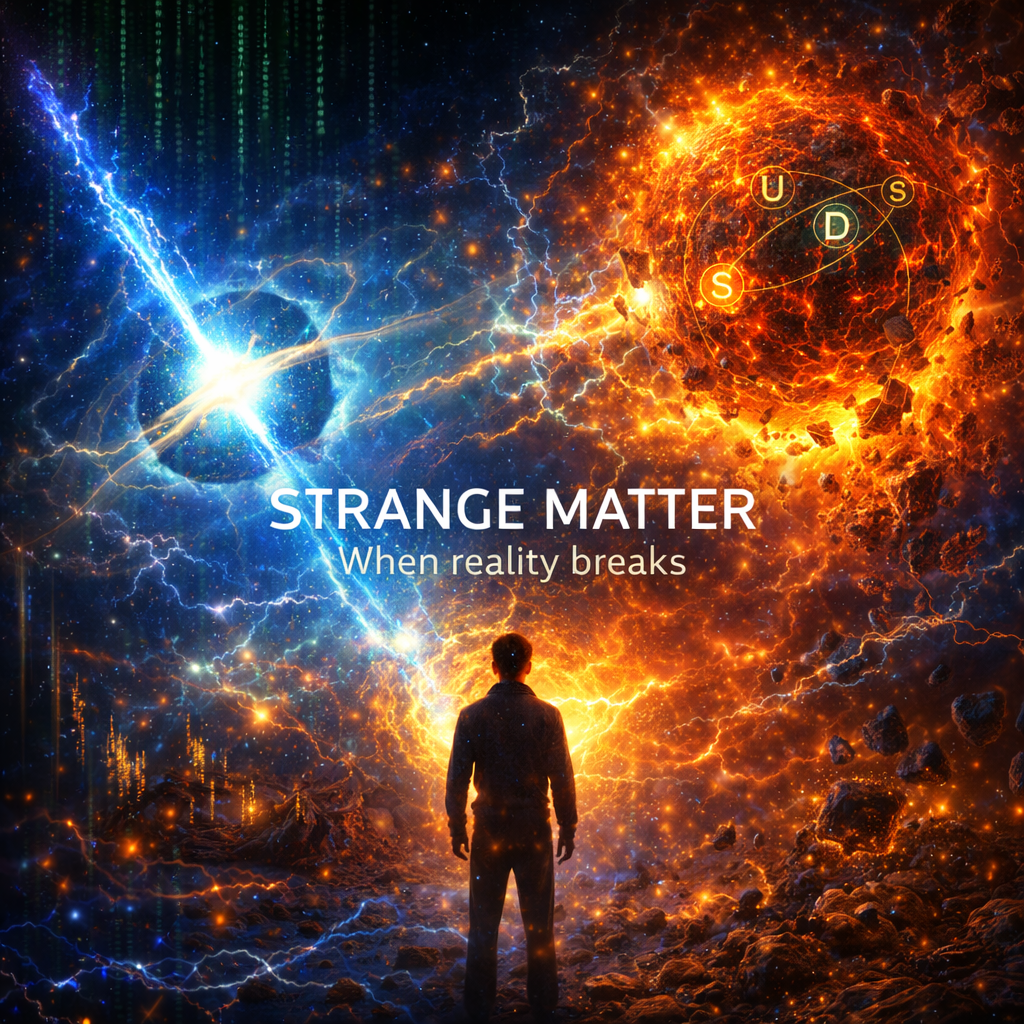
Where the Rules Do Not Bend
There are places in the universe where the rules do not bend.
They shatter.
Strange matter lives in those places.
Not in labs. Not in daily life. Not anywhere your body or mind could survive. It lives where gravity becomes a weapon, where atoms collapse under their own existence, and where matter itself is forced to ask a question it never had to answer before.
What are you really made of?
“Stability is always provisional.”
— Ilya Prigogine
The Illusion of Solidity
At the surface of reality, matter feels stable. Solid. Reliable. Tables stay tables. Bodies stay bodies. Atoms behave. But this stability is a convenience, not a guarantee. It exists only because the universe allows it to.
Take matter far enough from comfort and it begins to confess its secrets.
Inside a neutron star, gravity crushes matter so violently that atoms cease to exist. Electrons are forced into protons. Neutrons pile into one another until even neutrons give up their identity. What remains is not chemistry, not elements, not anything periodic tables were built to describe.
What remains may be quarks.
And under enough pressure, even quarks stop behaving politely.
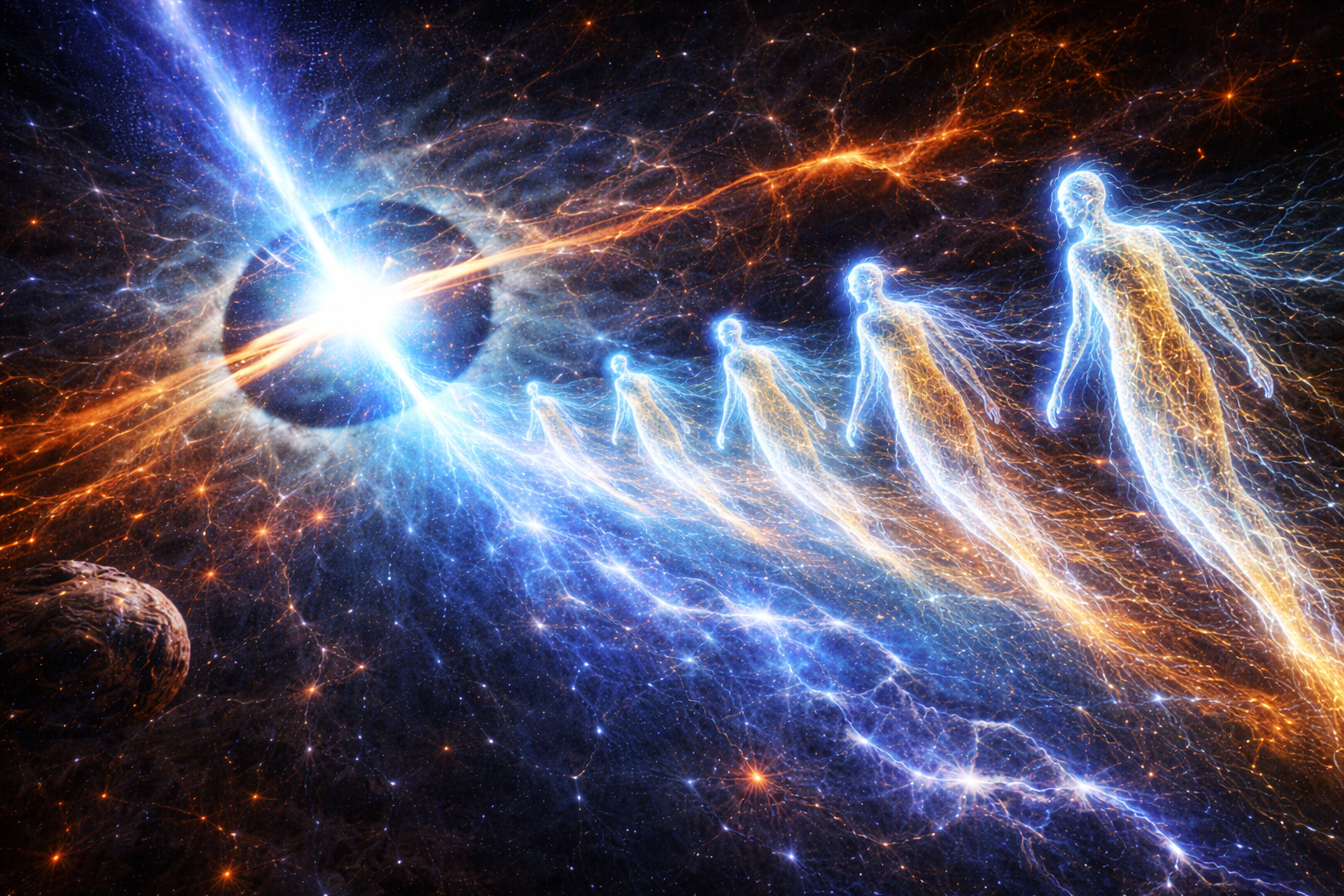
Drifting Into a Pulsar
Extreme Gravity, Perfect Rhythm, and the Illusion of Duplication
First, a definition.
A pulsar is a type of neutron star. It forms when a massive star dies, collapses under its own gravity, and compresses more mass than the Sun into a sphere roughly the size of a city. What remains is not a burning star, but a rotating core of collapsed matter so dense that a single teaspoon would weigh billions of tons.
Pulsars spin. And they spin fast.
Some rotate dozens, hundreds, even thousands of times per second. As they do, they emit narrow beams of electromagnetic radiation from their magnetic poles. These beams sweep through space like a lighthouse. When one passes Earth, we detect a pulse. Hence the name.
What makes pulsars extraordinary is not just their density, but their precision. Many pulsars rotate with a regularity that rivals atomic clocks. They are among the most rhythmically stable objects ever observed in the universe.
Now imagine drifting toward one.
Not physically surviving it. That part is impossible. But imagining it as a thought experiment, a way of exploring what extreme structure does to matter, information, and perception.
As you approach, space itself begins to behave differently. Gravity stretches distances. Time slows relative to the outside universe. The pulsar’s magnetic field dominates everything, threading space with invisible lines of force trillions of times stronger than anything we can generate on Earth.
Atoms do not remain atoms here.
Long before reaching the surface, tidal forces would pull you apart at the molecular level. But imagine, for a moment, that what is drifting inward is not a body, but consciousness. Or information. Or pattern.
The closer you move, the more the environment becomes defined by repetition.
The pulsar’s rotation imposes rhythm on everything nearby. Radiation flashes in perfect intervals. Magnetic fields oscillate. Particles are accelerated, redirected, and synchronized into vast, repeating structures.
From the outside, this looks like duplication.
Not because the pulsar is copying things intentionally, but because extreme regularity forces incoming signals to reappear, echo, and reconstruct in multiple forms. Information entering such a system can be stretched, smeared across time, and re-emitted in layered, repeating sequences.
In physics, this is not replication in the biological sense. It is pattern preservation under extreme constraint.
Signals passing through strong gravitational and electromagnetic fields can be distorted, delayed, split, and refracted. One input can appear as many outputs, offset in time and space. What feels like duplication is often the same information being expressed repeatedly as it is forced to conform to the system’s geometry.
In a pulsar’s environment, nothing is free to remain irregular.
Everything is entrained.
If consciousness were nothing more than information, rhythm, and structure, then passing into such a field would not destroy it immediately. It would reformat it.
The pulsar does not ask what you are. It only asks whether you can keep time.
In this sense, the idea of duplication becomes a metaphor grounded in physics. Under sufficient pressure and precision, systems stop allowing unique, one-off expressions. They force inputs into stable, repeating patterns. Variability collapses into symmetry.
The same way strange matter represents a more stable configuration than ordinary matter, a pulsar represents a more stable rhythm than most environments can sustain.
Anything entering it is either erased, or rewritten to match the beat.
This is why pulsars haunt both astrophysics and imagination.
They are not chaotic. They are not explosive. They are relentlessly ordered.
And order, taken far enough, can feel indistinguishable from replication.
Not because reality is copying itself, but because at extreme limits, there are fewer ways for structure to exist at all.
What survives is what can repeat.
What cannot, disappears.
When Matter Crosses a Threshold
This is where strange matter enters the story.
In theoretical physics, strange matter refers to a hypothetical state known as strange quark matter. Normal matter is built from up and down quarks. Strange matter adds a third participant to the collapse: the strange quark.
Under extreme density, physicists believe matter may reorganize into a soup of up, down, and strange quarks bound together in a single, ultra-dense phase. Not atoms. Not particles as we know them. A new ground state of matter entirely.
The unsettling part is not that this state might exist.
The unsettling part is that it might be more stable than the matter you are made of.
“Nature does not reveal herself all at once.”
— Pierre Curie
The Conversion Hypothesis
This leads to one of the most haunting ideas in modern physics.
If strange matter is truly stable, then ordinary matter may not be the universe’s preferred configuration. It may simply be a temporary arrangement that persists only because it has never been forced to choose otherwise.
In some theoretical models, if a stable fragment of strange matter were to come into contact with ordinary nuclear matter under the right conditions, the ordinary matter could convert into strange matter as well. Not copy its shape. Not mimic its form. Convert its fundamental structure.
A phase change at the deepest possible level.
This idea is sometimes called strange matter conversion. Informally, and more dramatically, it is described as strange matter “eating” normal matter. That phrase is misleading, but the implication remains disturbing.
Once matter crosses that threshold, there may be no going back.
Enter the Pulsar
Now enter the pulsar.
A pulsar is a neutron star that spins with terrifying precision, sweeping beams of radiation across space like a cosmic lighthouse. These objects are remnants of massive stars that collapsed so completely they left behind only gravity’s will.
Some physicists propose that certain pulsars are not neutron stars at all, but strange stars. Objects whose cores are composed of strange quark matter, locked into a configuration we can only model mathematically.
If true, these stars are not just dense.
They are fundamentally different from anything else in the universe.
They are matter that has crossed a line.
“There is no such thing as an isolated system.”
— Ludwig von Bertalanffy
The Thought Experiment That Won’t Go Away
Could you drift into one?
In any practical sense, no. Long before you reached anything resembling strange matter, tidal forces would rip you into subatomic debris. Your atoms would be erased by gravity long before conversion ever became relevant.
But the thought experiment persists for a reason.
Because it asks a question that has nothing to do with survival and everything to do with transformation.
What happens when structure can no longer hold?
When Scientists Took the Risk Seriously
Physicists took the strange matter idea seriously enough to worry about it.
When particle accelerators began colliding heavy ions at extreme energies, some scientists asked whether tiny droplets of strange matter, called strangelets, could form. If they did, and if strange matter were stable, could they trigger conversion?
This question led to formal safety analyses. The conclusion was reassuring. Cosmic rays collide at higher energies constantly. If strange matter conversion were easy or likely, the universe would already look very different.
The risk was deemed negligible.
The idea itself was not dismissed.
A Rare Scientific Category
Strange matter occupies a rare category in science.
It is mathematically consistent.
It is physically plausible under extreme conditions.
It is unobserved.
It is not ruled out.
It exists in that narrow corridor where science meets the edge of the unknown and refuses to look away.
“The most incomprehensible thing about the universe is that it is comprehensible.”
— Albert Einstein
Why the Idea Escapes Physics
That is why strange matter refuses to stay confined to astrophysics.
It represents the idea that stability is conditional. That identity depends on pressure. That transformation is not always gradual or reversible.
Under enough force, systems do not adapt.
They reconfigure.
There is no halfway state between normal matter and strange matter. There is only the crossing.
When Ideas Become Strange Matter
This is why the metaphor works so well beyond physics.
Ideas behave the same way.
Under normal conditions, thoughts orbit familiar patterns. Creativity feels incremental. Change is slow. But under enough pressure, intellectual or emotional, something different can happen.
Old frameworks collapse. Assumptions lose coherence. Concepts reorganize into structures that would have been impossible without stress.
After that point, there is no return to the old configuration.
The idea has become strange matter.
“Transformation is not improvement. It is reorganization.”
— Gregory Bateson
What Strange Matter Ultimately Reminds Us
The universe may contain only a few places where this transformation occurs. Or it may be more common than we realize, hidden in the cores of stars we cannot see clearly enough to judge.
Either way, strange matter reminds us of something essential.
Reality is not fixed.
Stability is not guaranteed.
And what feels fundamental may simply be what has never been tested hard enough.
In physics, strange matter is a question still waiting for evidence.
In thought, creativity, and consciousness, we encounter its analogue all the time.
Moments when pressure reorganizes everything.
Moments when there is no going back.
Moments when matter, mind, or meaning crosses a threshold and becomes something else entirely.
References and Sources
Farhi, E., and Jaffe, R. L. Strange Matter. Physical Review D, 1984.
Foundational theoretical work on strange quark matter stability.
Alcock, C., Farhi, E., and Olinto, A. Strange Stars. The Astrophysical Journal, 1986.
Introduced the concept of stars composed of strange quark matter.
Madsen, J. Physics and Astrophysics of Strange Quark Matter. Lecture Notes in Physics, 1999.
Comprehensive review of strange matter theory and astrophysical implications.
Weber, F. Strange Quark Matter and Compact Stars. Progress in Particle and Nuclear Physics, 2005.
Detailed discussion of neutron stars and strange stars.
CERN Safety Review of Heavy Ion Collisions, early 2000s.
Analyses addressing strangelet formation and risk.
NASA and astrophysics reviews on neutron stars and pulsars.
Context for extreme density environments where exotic matter may exist.