Cosmic Mind Mapping
This article may sound like a bunch of new age mumbo jumbo. Yes it is “out there”. But this is the Mad Hatter’s Codex for a reason. We get weird here. We travel crazy roads to get to a point of sanity again. Please understand, I’m not stating any of this as fact. Just a fun abstract examination of the mind and thinking about how we think in a new light. Simply a connection of cosmic concepts to mental psychology in an effort to spur new thought processes and jolt creativity. If it confuses you, that’s ok. It confused me writing it quite a few times. But no doubt, something odd happens to the mind when it connects our inner world to the outer world…something deeper takes place. Something that transcends having to “understand” and instead turns inward to just play and expand in ways absent of result. Have fun reading. Get lost and find some things along the way you maybe didn’t know you were missing. Just don’t lose your car keys in the black hole portion like I did.
The cosmos gives shape to forces that are otherwise invisible. Physics turns the unseen into something you can point at. The mind does the same thing, except the arena is inside your skull and the measurements are feelings, attention, memory, identity, and time.
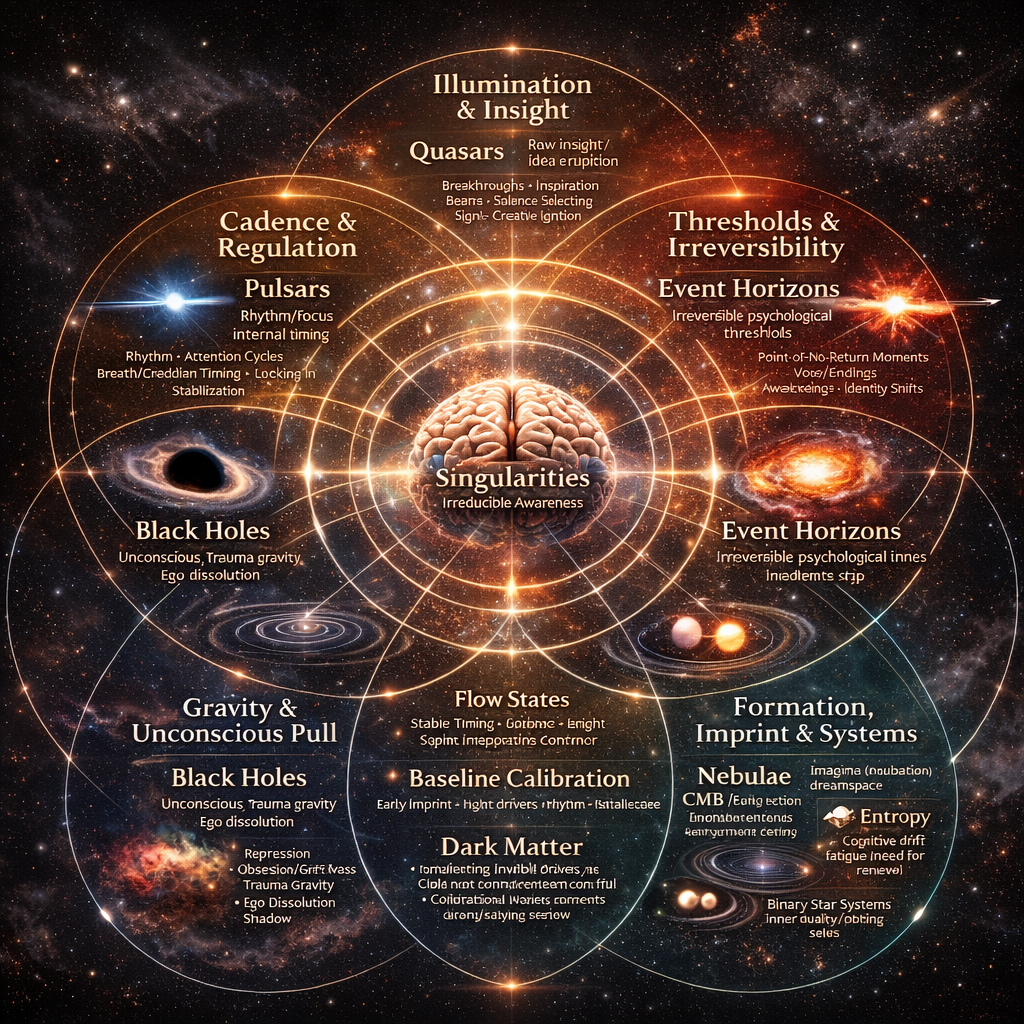
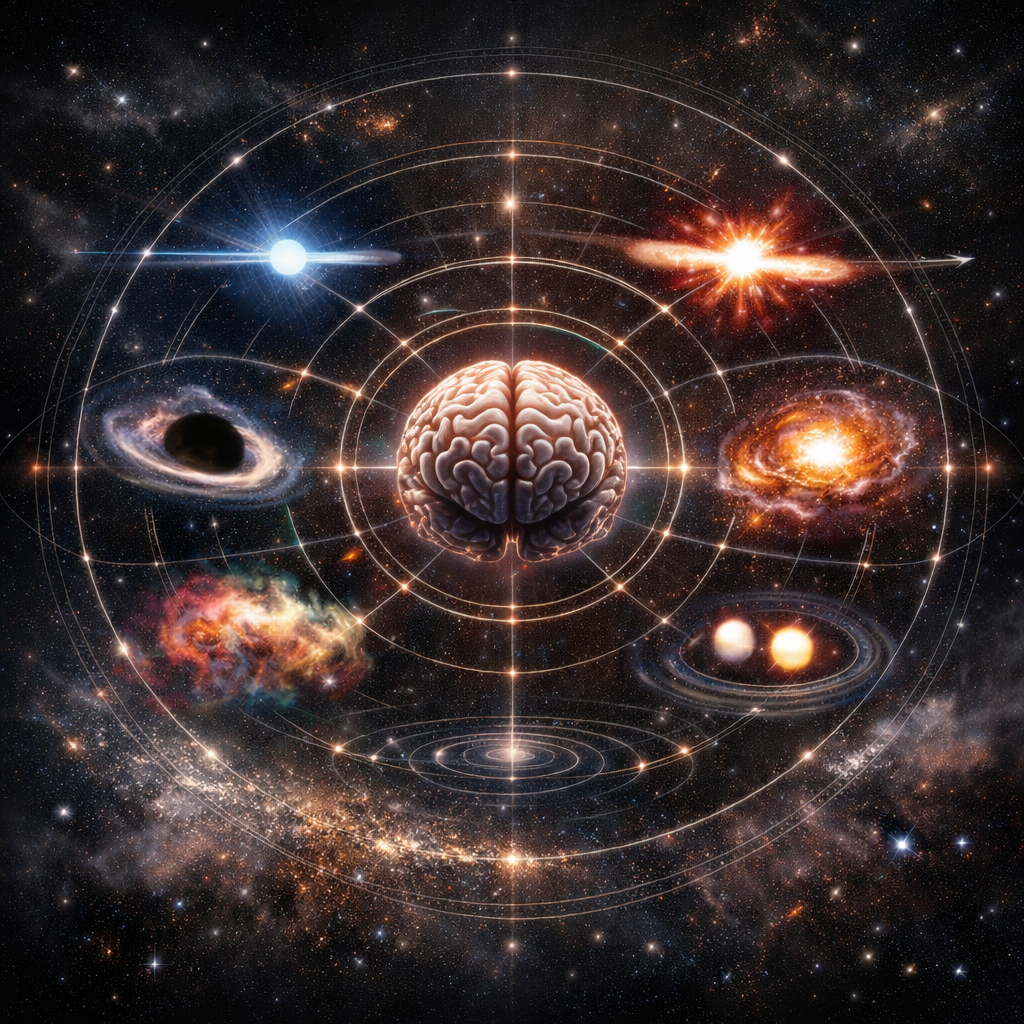
The map below is not claiming the brain is literally a galaxy. The move is more precise than that. It is pattern matching. The universe has recurring behaviors, like rhythm, eruption, collapse, threshold, incubation, imprinting, resonance, duality, drift. The nervous system has recurring behaviors with the same emotional geometry.
So the Archive Chamber Atlas treats each cosmic phenomenon as a cinematic mirror. On one side, the sky. On the other, the mind. And in the middle, the machinery, brain regions and networks that make the analogy feel real.
Pulsars
the rhythm of focus
1) What it isn’t
A pulsar isn’t “a star that flashes.” It’s a dead star’s core turned into a timing engine.
2) The physical mechanism as a moving chain
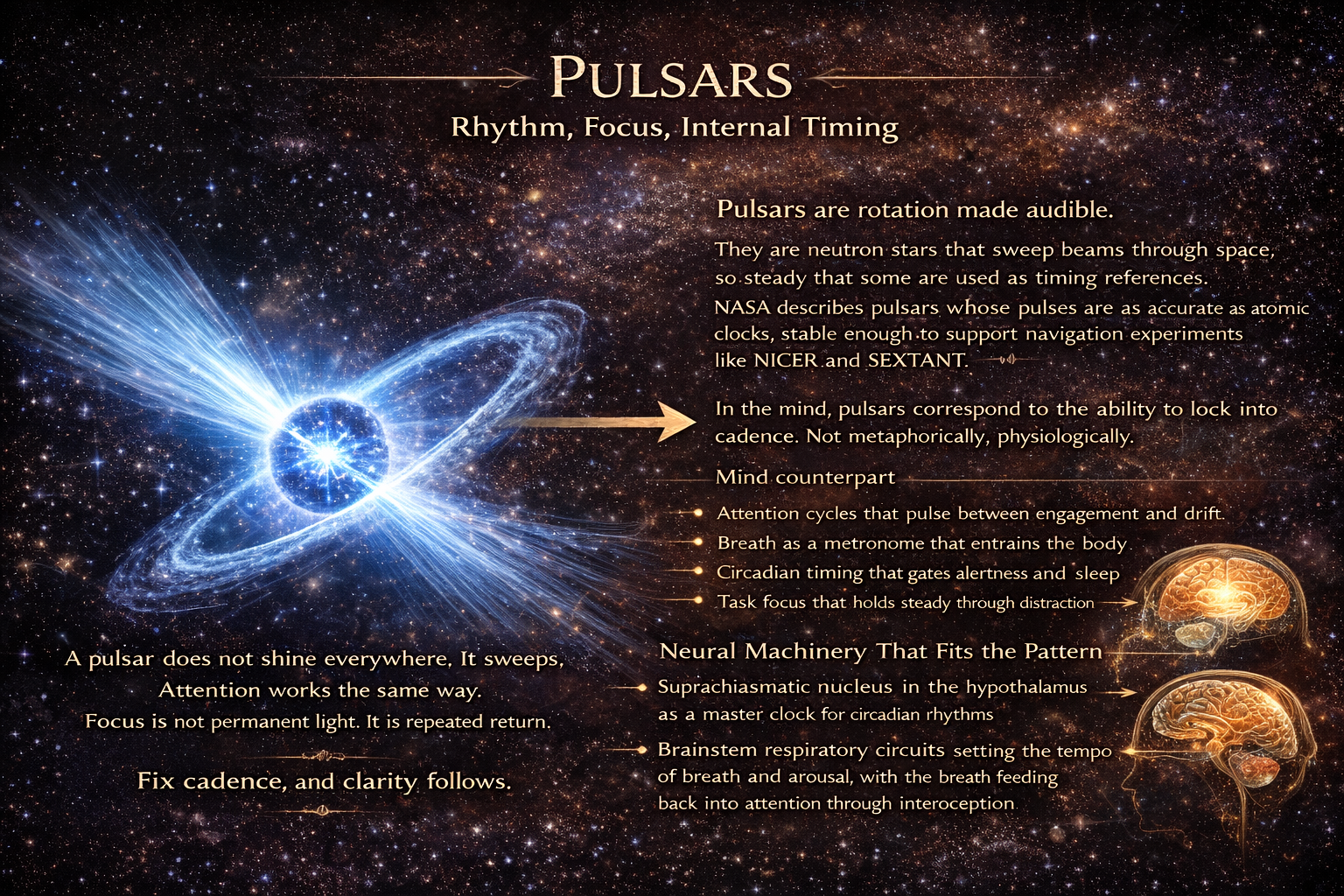
A massive star collapses into a neutron star. It spins fast. Its magnetic poles throw out beams of electromagnetic radiation. As it rotates, those beams sweep across space like a lighthouse, producing pulses with extraordinary regularity. Some millisecond pulsars are stable enough that their pulse timing can rival atomic-clock stability, which is why NASA has pursued pulsar-based navigation and timing concepts (including NICER/SEXTANT work).
3) The one-sentence engine
A pulsar converts rotation into reliable signal.
4) The pivot to mind
Inside you, focus is also a signal problem, not a personality trait.
5) The mind’s raw material
Before “concentration” shows up, you’re working with unstable ingredients: fluctuating arousal, restless attention, scattered urges, fatigue, and sensory noise—everything that makes the beam wobble.
6) The same mechanism in mental terms
Focus doesn’t shine everywhere. It sweeps. It returns. It lands on the task, drifts, and comes back again—rhythmically—until the pattern stabilizes. The mind’s “pulse” is the repeated realignment that keeps attention from dissolving into static.
7) The subjective output
When it’s working, you feel it as cadence:
attention cycles that pulse between engagement and drift
breath acting like a metronome that steadies you
wake and sleep gates that stop fighting you
task focus that holds through distraction
8) The instrument panel in the brain
This cadence has hardware:
The suprachiasmatic nucleus (SCN) in the hypothalamus functions as the body’s central circadian pacemaker, coordinating daily rhythms that strongly affect alertness and sleep timing.
Brainstem respiratory circuits generate breathing rhythm, and respiratory rhythms can couple into brain activity and cognition—one reason breath can change attention state so quickly.
The cerebellum and basal ganglia support timing, prediction, and the chunking/smoothing of sequences—helping you feel “in time” rather than chasing the moment. Evidence from motor learning work links basal ganglia to sequence learning and chunking, with complementary cerebellar roles in motor control and learning.
9) The failure mode
When the system can’t hold rhythm, the beam can’t stay coherent. Constant interruption keeps attention thin. Poor sleep timing, stress overload, shallow breathing, and chaotic routines push the internal clock off-beat—so “trying harder” just adds strain.
10) The built-in warning
A pulsar’s power is consistency, not brightness. If you chase intensity instead of cadence, you get short bursts and long drift—spotlights, not signal.
11) The operator manual
Protect circadian anchors (wake time, light cues, wind-down timing) so the SCN can keep a stable beat.
Use breath as a quick retuner when attention scatters, because respiratory rhythm can organize brain dynamics.
Design focus around return: short cycles, clean resets, repeatable starts—so the beam learns its sweep.
12) The seal
A pulsar doesn’t shine everywhere. It sweeps and comes back—precise enough to navigate by.
Train focus the same way: fix cadence, and clarity follows.
Quasars
gravitational lighthouses for idea eruption
1) What it isn’t
A quasar is not the black hole. It is the blaze around it.
2) The physical mechanism as a moving chain
A supermassive black hole sits at a galaxy’s center. Gas and dust get captured, spiral inward, and form a hot accretion flow where infalling material releases enormous energy. The galaxy’s core becomes so luminous it can outshine its host, which is why quasars read like gravitational lighthouses across vast distance.
3) The one-sentence engine
A quasar converts gathered mass, pressure, and motion into a focused beam of illumination.
4) The pivot to mind
Inside the mind, insight is also a conversion event, pressure becoming clarity.
5) The mind’s raw material
Before an idea becomes a sentence, it shows up as debris with charge. A phrase that will not leave. A stubborn question. A contradiction that keeps scraping. A pattern you keep catching out of the corner of reality. The sense of something gathering gravity.
6) The same mechanism in mental terms
The mind pulls that material into orbit. Notes stack. Conversations seed. Images collide with facts. A memory touches a headline. Separate fragments get forced into proximity until friction appears. Then density crosses a threshold and ignition happens. What looked like a sudden beam was the end of a long accretion.
7) The subjective output
When it hits, it can feel fully formed.
A creative download too bright for the room.
Intellectual ignition where scattered pieces snap into one spine.
Sometimes the manic edge appears too, speed outrunning integration and the beam feels almost dangerous.
8) The instrument panel in the brain
This snap has a plausible internal choreography.
The salience network, anchored in the anterior insula and anterior cingulate cortex, helps decide what matters and shifts control toward the signal that wins.
The prefrontal cortex supports cognitive control and goal maintenance, holding attention steady long enough for compression to complete.
The anterior insula links bodily state to subjective feeling and interoceptive attention, which fits why insight often arrives with a physical signature, a surge, a chill, a sudden certainty before the words show up.
9) The failure mode
Scattered minds do not fail from lack of intelligence. They fail from lack of density. Constant interruption keeps everything thin, so nothing gets enough sustained pressure to convert into a coherent beam. No orbit, no friction, no ignition.
10) The built-in warning
Quasars are bright because conditions are extreme. Inspiration can be ecstatic and destabilizing when the nervous system cannot regulate the surge. The beam is not the whole story. Integration is what makes it usable.
11) The operator manual
Treat your notebook like an accretion disk, capture fragments and contradictions, let debris become fuel.
Choose one question to orbit for thirty days, give the mind a center of pull.
Decide the container before the beam arrives, page, voice note, sketch, mind map, single slide.
Learn the difference between brilliance and glare, brilliance organizes next steps, glare accelerates without structure.
Integrate before you announce, sleep, walk, eat, return, if the beam holds after the body settles, it is ready.
12) The seal
Quasars are gravitational lighthouses for idea eruption.
So is a mind that gathers material with patience, compresses it with focus, and builds a container strong enough to hold what it illuminates.
Black holes
The unconscious, trauma gravity, ego dissolution
Black Holes
1) What it isn’t
A black hole isn’t a “cosmic vacuum cleaner.” It doesn’t roam hunting stars. It’s a region where gravity becomes so extreme that escape stops being an option.
2) The physical mechanism as a moving chain
Mass collapses into a compact object. Gravity deepens. Spacetime curves harder and harder as you approach. A boundary forms around the system, the event horizon, beyond which nothing can escape, not even light. NASA describes the event horizon as the point of no return, the boundary surrounding a black hole where escape becomes impossible.
3) The one-sentence engine
A black hole converts too much mass in too little space into inescapable inward pull.
4) The pivot to mind
Inside the mind, some experiences also become gravity wells—attention collapses inward and the self-story bends around what it cannot release.
5) The mind’s raw material
Before it becomes “the unconscious,” it starts as unprocessed mass: threat that never resolved, grief that never completed, memory fragments that never integrated, urges and avoidances that quietly reorder life from underneath.
6) The same mechanism in mental terms
The psyche compresses what it can’t metabolize. The compressed material pulls attention into orbit. You don’t have to choose it—your mind returns to it automatically. Avoidance strengthens the gravity. Obsession tightens the orbit. Meaning warps. Time warps. The closer you get, the more everything else starts revolving around it.
7) The subjective output
Black-hole mind states show up as:
repression and avoidance that keep pulling experience underground
obsessions that swallow time and narrow the world
grief that bends meaning until everything orbits one loss
identity collapse when the old narrative cannot hold
deep contemplative states where ego boundaries soften and the “self” feels less solid
8) The instrument panel in the brain
There’s recognizable circuitry behind this gravity.
The extended amygdala is deeply involved in threat processing and survival-oriented defensive states, shaping what feels urgent, dangerous, or unavoidable.
The hippocampus and medial temporal lobe memory system are central to forming and consolidating episodic memory, the raw material the mind uses to build “what happened” into “who I am.”
The default mode network (DMN) is strongly linked with self-referential processing, autobiographical memory, and internal narrative—powerful functions that can become a closed loop when the system is stuck.
9) The failure mode
A black hole doesn’t announce itself with light. It announces itself through what it bends. The mind does the same. The unconscious isn’t only hidden content. It’s the force that shapes behavior without permission—what you can’t stop thinking about, what you keep avoiding, what your body interprets as danger even when your logic disagrees.
10) The built-in warning
Not every inward pull is truth. Some gravity is guidance. Some gravity is old survival code. If you mistake gravity for reality, you orbit forever.
11) The operator manual
The goal isn’t to stare into the void for aesthetics. It’s to change the physics.
Add processing so compressed material can unfold safely: naming, narrative integration, grief completion, regulated exposure, somatic discharge—whatever method actually reduces mass instead of packing it tighter.
Add distance with skill: observe the orbit without letting it become the whole sky.
Add structure: sleep, rhythm, relational safety—because regulation is the scaffolding that lets processing occur.
12) The seal
Black holes teach one brutal rule: what isn’t processed becomes mass—and mass becomes gravity.
Event horizons
Psychological thresholds and irreversible shifts
1) What it isn’t
An event horizon isn’t the black hole itself. It’s the boundary where the possibility of “returning to normal” stops existing.
2) The physical mechanism as a moving chain
Approach a black hole and gravity escalates. Spacetime curvature steepens. Near a critical boundary, escape routes collapse. Cross that boundary and even light can’t get back out. NASA describes the event horizon as the point of no return and the boundary beyond which nothing, not even light, can escape.
3) The one-sentence engine
An event horizon converts approach into irreversibility.
4) The pivot to mind
Inside the mind, some moments are boundaries with consequences. Cross them, and perception cannot return to its prior configuration.
5) The mind’s raw material
Before the shift becomes obvious, it gathers as pressure at the edge: growing dissonance, repeated “something’s off,” mounting conflict between what you know and what you’ve been pretending, a truth you keep circling but won’t touch.
6) The same mechanism in mental terms
The brain draws boundaries all day, most of them soft. But certain experiences tighten into a hard line. You approach a realization, a decision, an exposure, a rupture. You circle it. You resist it. Then one day you cross it. After that, the old self-story can’t reassemble the same way. The rule-set changes. The timeline splits into before and after.
7) The subjective output
Event-horizon mind states show up as:
trauma moments that permanently alter threat calibration
awakenings that collapse an old belief system
irreversible decisions, vows, endings, departures
rites of passage that rewire belonging
The feeling is unmistakable. Before, you could pretend. After, the pretense is unavailable. Before, you believed the story. After, you see the mechanism.
8) The instrument panel in the brain
This kind of “switch” has a plausible neural signature:
The salience network is linked to detecting what matters and initiating switching between large-scale brain networks, including shifting between internally focused and externally focused control modes.
The anterior cingulate cortex (ACC) is strongly associated with conflict monitoring and signaling the need for adjustments in cognitive control.
Amygdala–prefrontal interactions are central to fear learning and regulation, shaping how threat responses and top-down control trade power under stress.
9) The failure mode
The common mistake is treating a hard boundary like a soft one. People keep trying to negotiate with a truth that already crossed the line. They reach for motivation, hacks, and willpower, when what’s actually happening is irreversible reconfiguration. The mind keeps trying to “go back,” and that refusal to accept the boundary becomes its own loop.
10) The built-in warning
Not every intense moment is an event horizon. Some are storms that pass. The signature of a true horizon is structural: afterward, the old narrative won’t hold, even if you try to force it.
11) The operator manual
Name the boundary without dramatizing it: “This is a point of no return for me.” Precision beats performance.
Build a new rule-set: if the old identity can’t operate, write the new operating principles in plain language.
Choose clean rituals for crossing: a conversation, a letter, a public vow, a private vow, a symbolic ending—something that marks the shift so your nervous system stops hunting for the old timeline.
If the horizon was trauma, prioritize regulation first, because control systems don’t integrate well while the threat system is dominating.
12) The seal
An event horizon is a boundary with consequences. Cross it, and the rules change.
Sometimes you don’t need more motivation. You need to recognize the threshold already happened—and stop trying to live in a timeline that ended.
Singularities
Core self and irreducible awareness
In physics, a singularity is where models break down. It is the limit point where known equations stop being sufficient.
The mind has a similar place. Not as a measurable dot in the brain, but as a lived fact. At the center of experience, before language, before autobiography, there is awareness.
1) What it isn’t
A singularity isn’t a “thing you can point at” the way you point at a planet. It’s the place where the map stops being trustworthy.
2) The physical mechanism as a moving chain
In general relativity, you can drive equations toward conditions of extreme compression where curvature and density shoot toward pathological values, and the theory’s usual way of describing spacetime breaks down. Philosophers of physics summarize spacetime singularities as breakdowns in spacetime’s basic structure, often treated as an “edge” of spacetime where predictability fails. Einstein Online frames singularities as “pathological behavior” predicted by models, a signal that the theory is being pushed beyond its reliable domain. NASA’s black-hole anatomy page notes that relativity predicts a singularity at a black hole’s center and that this prediction may mark the limits of relativity, where quantum effects likely matter.
3) The one-sentence engine
A singularity is where compression exceeds explanation and the model stops making useful predictions.
4) The pivot to mind
Inside the mind, there’s a comparable boundary. Not a measurable dot in the brain, but a lived fact: the point where language and narrative can’t fully capture what’s happening, yet awareness remains.
5) The mind’s raw material
Before “core self” is even a concept, there’s raw experience: sensation before labels, presence before story, the felt sense before words, the quiet knowing that exists prior to interpretation.
6) The same mechanism in mental terms
Thoughts, identities, and explanations orbit experience like models orbit reality. Most of the time, the models work. Then you approach certain inner depths and the usual equations fail. You can still sense, still witness, still be—yet the narrating mind can’t pin it down cleanly. The closer you get, the more the attempt to define it distorts it. Then you reach the edge: explanation collapses, awareness doesn’t.
7) The subjective output
Singularity-states show up as:
preverbal knowing, the felt sense before words
the raw witness state in deep quiet
the moment you realize thoughts are objects, not you
the paradox of self, undeniable yet ungraspable
8) The instrument panel in the brain
Neuroscience does not identify a single anatomical “core self” like a city on a map. What it does show are networks that reliably support self-referential processing and internal narrative—especially the default mode network and cortical midline structures. Reviews and meta-analyses link the DMN to self-reference, autobiographical memory, and mind-wandering, and connect midline regions to self-related processing.
That matters because it implies something subtle: the “self story” has circuitry. The witness behind the story is harder to localize, because it’s closer to the condition of experiencing than a specific content being experienced.
9) The failure mode
The trap is living as if the narration is the whole self. When the DMN-story machine is treated as absolute, you get stuck in loops: rumination, identity rigidity, compulsive meaning-making—trying to “solve” what can only be met. The singularity becomes a panic point instead of a clarity point.
10) The built-in warning
A singularity is not an excuse to abandon reason. It’s a reminder of limits. In physics, singularities often signal “the theory needs more.” In inner life, they signal the same: your current language, identity, or framework is insufficient—not that reality has disappeared.
11) The operator manual
Stop trying to force perfect words at the edge. Use lighter labels: “felt sense,” “presence,” “witness.”
Shift from explanation to observation: track sensations, images, impulses, without immediately narrating them into a story.
Practice “model humility”: treat your identity statements as provisional, not ultimate.
If you’re writing, capture the singularity indirectly: through metaphor, negative space, or contradiction—because the attempt to define it head-on often flattens it.
12) The seal
In Archive Chamber terms, it’s the locked room behind the locked rooms. You can describe the hallway. You can describe the doors. Then you reach the edge of description—where explanation ends and experience begins.
Nebulae
Imagination, incubation, dreamspace
1) What it isn’t
A nebula isn’t “empty space with pretty colors.” It’s matter in the middle of becoming—unfinished on purpose.
2) The physical mechanism as a moving chain
Stars don’t start out as stars. They begin inside vast clouds of gas and dust. Gravity concentrates pockets inside these clouds until dense clumps collapse, warming into protostars still wrapped in their birth material. NASA describes star formation as beginning in large clouds of gas and dust, with gravity pulling dense clumps inward until collapse begins. Hubble’s recent coverage of protostars in Orion shows these forming stars embedded in envelopes of gas and dust, carving cavities with jets and winds as they grow.
3) The one-sentence engine
A nebula converts diffuse material + time + gravity into a viable new form.
4) The pivot to mind
Inside the mind, imagination works the same way. Before a clear idea exists, there’s a living cloud.
5) The mind’s raw material
Fragments. Images without captions. Emotional tones without names. Half-thoughts. Strange connections that feel meaningful but refuse to explain themselves. The “fog” that modern brains try to bully into instant clarity.
6) The same mechanism in mental terms
Your mind gathers experiences like dust. It holds them loosely, lets them drift, then slowly draws them together through repetition, association, and quiet replay. Nothing looks finished at first. Then certain clusters get denser. A theme starts to form. A concept gains heat. A shape appears—still soft—until it can finally stand as something you can say.
7) The subjective output
Nebula-states feel like:
hypnagogic imagery and dream logic
subconscious creativity assembling parts
incubation phases where “not thinking” is actually work
productive uncertainty, the fog before clarity
8) The instrument panel in the brain
There’s recognizable circuitry behind this nursery-phase:
The default mode network (DMN) tends to be active during rest and internally oriented cognition like mind-wandering and internal simulation—exactly the mental conditions where incubation thrives.
Hippocampal memory systems supply the ingredients—episodes, fragments, associations—and help recombine prior experience in ways that support creative association and ideation. Recent work continues to link hippocampal–prefrontal interactions and episodic retrieval to creative performance.
9) The failure mode
This is where modern minds suffer. They demand immediate articulation and label fog as incompetence. They rush the nursery, forcing premature certainty. That pressure doesn’t create stars—it collapses the cloud into noise, anxiety, or shallow clichés.
10) The built-in warning
A nebula can also stay a nebula forever if it never gets protected long enough to densify. Incubation isn’t avoidance. It’s a phase with its own intelligence, but it still needs gravity—return, constraint, and time.
11) The operator manual
Give the cloud a safe container: a notes file for fragments only, no forced conclusions.
Use deliberate “idle time” as fuel: walks, showers, low-stimulation downtime—prime territory for DMN-style internal simulation.
Feed the nursery with inputs, then stop poking it: read, observe, collect—then let the associations cook.
Add gentle gravity: one guiding question, one theme, one constraint—enough to draw the dust together without crushing it.
12) The seal
A nebula is not a failure to be a star. It’s the necessary condition for formation.
Protect the fog, and the shape will arrive.
Supernovae
Psychological collapse into transformation
1) What it isn’t
A supernova is not a star gently fading out. It is a terminal event that releases more energy in a moment than most stars do across a lifetime.
2) The physical mechanism as a moving chain
A massive star runs low on fuel that supports outward pressure. Gravity wins. The core collapses, the star destabilizes, and the result is a catastrophic explosion that ejects material outward. NASA describes supernovae as massive stellar explosions that occur when a star can no longer sustain fusion pressure against gravity. These explosions also distribute elements into space, including heavier elements that later become part of new stars, planets, and life.
3) The one-sentence engine
A supernova converts collapsed structure and extreme pressure into violent release that seeds new creation.
4) The pivot to mind
Inside the mind, transformation can follow the same physics. When internal pressure exceeds the capacity of the current identity structure, something gives, and what comes out can become the raw material for a new self.
5) The mind’s raw material
Long before the blowout, there are warning signs that feel like quiet heat. Chronic misalignment. Suppressed emotion stacking up. A life built on coping strategies that once worked, now cracking. The sense that you are holding together something that is already past its limits.
6) The same mechanism in mental terms
The psyche can maintain a functional shell for a long time. Then the core runs out of fuel. The old system cannot keep generating the pressure needed to stay stable. Collapse begins internally, sometimes invisibly. Then a triggering event arrives, a deadline, a loss, a betrayal, a truth, an illness, a realization, and the structure fails. What follows is release. It can look like breakdown, but it is also a redistribution of inner material. Debris moves. New elements become available.
7) The subjective output
Supernova mind states show up as
burnout that exposes misalignment
catharsis that clears suppressed emotion
a life event that rearranges priorities overnight
spiritual crisis that becomes a deeper architecture
They feel terrifying because they feel like endings. They are also honest. They reveal what was unstable.
8) The instrument panel in the brain
The brain reorganizes through experience and stress, not just through time. Neuroplasticity describes the capacity for the brain to modify connections in response to experience, learning, and injury. Memory systems also change with time and reconsolidation. Systems consolidation describes how memories that initially rely heavily on the hippocampus become reorganized across distributed cortical regions. Under high stress, threat and regulation systems can shift balance, including amygdala and prefrontal interactions that shape how fear and control trade power.
Put simply, the nervous system can rewrite its operating model after major impact. That is part of why a psychological collapse can later become a new architecture.
9) The failure mode
The danger is treating the explosion as meaningless damage. People panic and try to rebuild the exact same structure that failed, fast, rigid, and performative. That turns debris into poison. It becomes shame, avoidance, and repetitive survival loops. The system stays scorched but not transformed.
10) The built-in warning
Do not romanticize supernovae. In the sky, they destroy what existed. In life, breakdowns carry real cost. The only reason the metaphor is useful is because it stays honest. Transformation is not a vibe. It is a consequence of pressure meeting limits.
11) The operator manual
Name what collapsed, specifically. Not my life, but this identity, this schedule, this relationship pattern, this belief about who I must be.
Stabilize first, then interpret. When the system is still in shock, it will narrate in extremes.
Sort the debris. Keep what is true. Discard what was only performance.
Build a new structure out of new elements, smaller commitments, cleaner boundaries, a truer pace, relationships that support regulation, and work that matches values.
Give it time. Reorganization is not instant. Neuroplastic change is real, but it is iterative, built by repeated experience.
12) The seal
A supernova is collapse that becomes release, and release that seeds new worlds.
Your breakdown does not have to become poison. It can become material.
Dark matter
Invisible drivers of behavior
1) What it isn’t
Dark matter isn’t “dark” because it’s evil or shadowy. It’s dark because it doesn’t emit light—so you can’t see it directly, even while it’s shaping everything.
2) The physical mechanism as a moving chain
Astronomers observe galaxies rotating and clustering as if there’s more mass than what telescopes can detect. The visible matter alone can’t account for the gravitational behavior. So dark matter is inferred through its effects: it bends trajectories, holds structures together, and explains motion that would otherwise not add up. NASA describes dark matter as something we cannot directly observe, but we detect through its gravitational influence on visible matter.
3) The one-sentence engine
Dark matter is invisible mass revealed by visible consequences.
4) The pivot to mind
Inside the mind, the strongest drivers are often the ones you can’t see directly—yet their gravity shows up everywhere.
5) The mind’s raw material
Before you ever “choose,” there’s a hidden stack of inputs: early conditioning, implicit beliefs, social scripts, fear learning, reward learning, family patterns, identity protection, and the nervous system’s default calibration. Most of it operates below narration.
6) The same mechanism in mental terms
You watch the behavior—the orbit—and you infer the mass. Someone reacts too fast. Avoids too consistently. Chases the wrong thing again. Freezes at the same point every time. The conscious story gives reasons, but the pattern keeps repeating. That repetition is gravity. The unseen architecture is shaping the visible motion.
7) The subjective output
Dark-matter mind states show up as:
implicit beliefs and conditioning
automatic reactions before conscious choice
cultural programming that feels like personal preference
ancestral and developmental imprints that set nervous-system defaults
And it produces the most frustrating human sentence: I don’t know why I did that.
8) The instrument panel in the brain
There’s real machinery that fits the metaphor:
The basal ganglia and striatum are deeply involved in habit learning and stimulus–response patterns that can run with limited conscious access, especially once behaviors are chunked into routines.
The amygdala and extended amygdala rapidly tag salience and threat relevance—often faster than deliberate cognition can intervene, shaping what feels urgent, dangerous, or compelling.
The default mode network supports self-referential processing and meaning-making, generating an ongoing narrative that can rationalize actions after the fact while the deeper drivers remain unseen.
9) The failure mode
The trap is moralizing what is actually gravitational. People try to “be better” through shame and willpower while the invisible mass stays intact. The spotlight of consciousness argues. The stage rigging keeps pulling the curtains. Without detecting the hidden driver, the orbit doesn’t change.
10) The built-in warning
Not everything unseen is destiny. Dark matter is not fate. It’s simply unobserved structure. The danger is confusing your conscious story for the full control room.
11) The operator manual
Track orbits, not excuses: where do you reliably overreact, underreact, freeze, chase, avoid, repeat.
Look for gravitational fingerprints: the emotion that spikes first, the belief that shows up underneath, the reward you’re secretly pursuing, the threat you’re quietly avoiding.
Intervene at the system level: change cues, routines, environments, and relationships—not just intentions—because habits and threat tagging are context-sensitive.
Rewrite the narrative only after you’ve found the mass. Otherwise you’re decorating the spotlight.
12) The seal
Consciousness is not the whole control room. It’s a spotlight.
Dark matter is the rigging behind the stage—revealed by the motion it makes. Study the gravity, and you can change the orbit.
Dark energy
Expansion impulse and future orientation
1) What it isn’t
Dark energy isn’t “dark” because it’s negative. It’s dark because we don’t directly see it—yet the universe behaves as if it’s there, pushing outward.
2) The physical mechanism as a moving chain
Astronomers observe that the universe is expanding, and that the expansion is accelerating. The name “dark energy” is assigned to whatever is driving that acceleration—an effect that becomes dominant as the universe evolves. NASA notes that the expansion of the universe has begun to speed up again as the repulsive effects of dark energy dominate.
3) The one-sentence engine
Dark energy is an invisible outward push revealed by accelerating expansion.
4) The pivot to mind
Inside the mind, there’s an analogous force: the urge to become—an expansion impulse that keeps pulling you forward.
5) The mind’s raw material
Before it becomes a goal, it starts as signal: restlessness, curiosity, dissatisfaction that isn’t depression, a quiet hunger, a future-self pressure you can’t quite explain, a sense that staying the same is decay.
6) The same mechanism in mental terms
The psyche expands when an internal vector keeps increasing the distance between you and your old boundaries. First it’s a nudge. Then it becomes momentum. Then the “repulsive” feeling grows—repulsive not as disgust, but as a refusal of stagnation. The old life starts to feel too tight. You don’t always know where you’re going, but you feel the push away from what no longer fits.
7) The subjective output
Dark-energy mind states show up as:
ambition that doesn’t require external permission
curiosity that pulls you toward unknown doors
longing, the felt gravity of a future self
evolutionary restlessness, the sense that staying the same is decay
It isn’t always hustle. Sometimes it’s quiet. It’s the inner yes that keeps nudging even while the conscious mind argues.
8) The instrument panel in the brain
There’s plausible biology for an “expansion mode.”
The locus coeruleus–norepinephrine (LC-NE) system is linked to regulating arousal and adaptive gain, influencing shifts between exploration and exploitation modes—how ready you are to seek novelty versus stay locked on a known task.
The salience network helps determine what feels significant and action-worthy, selecting which possible futures rise above noise and become compelling enough to pursue.
9) The failure mode
The trap is confusing motion with meaning. Dark energy can become acceleration without direction—restlessness that burns time, novelty addiction, constant reinvention that never lands, ambition that expands but doesn’t build.
10) The built-in warning
Not every urge to expand is wisdom. Sometimes it’s avoidance wearing visionary clothes. The signature difference is whether the push creates coherence or fragmentation.
11) The operator manual
Translate restlessness into a vector: write the one sentence that names what’s too tight and what wants more room.
Choose one unknown door at a time. Expansion without constraint becomes scatter.
Use “quiet yes” as a metric: if the pull persists after sleep, after food, after calm, it’s likely signal, not impulse.
Anchor exploration to a rhythm and a container—so the outward push turns into building, not just moving.
12) The seal
Dark energy is the universe accelerating into more space.
In you, it’s the inner expansion that won’t apologize—growth with purpose, not speed for its own sake.
Cosmic microwave background
Earliest memory imprint and baseline emotional weather
Cosmic Microwave Background
1) What it isn’t
The CMB isn’t “random static.” It’s not noise. It’s a message that looks like noise until you learn how to read it.
2) The physical mechanism as a moving chain
Early on, the universe was hot and dense enough that light couldn’t travel freely. As it expanded and cooled, there came a moment when photons could finally move without being constantly scattered. What we call the cosmic microwave background is that lingering afterglow, carrying a frozen imprint of early conditions. NASA’s WMAP overview describes the “afterglow light” as being emitted about 375,000 years after inflation, with earlier conditions imprinted on it.
3) The one-sentence engine
The CMB is ancient light that preserves an early imprint as a background baseline.
4) The pivot to mind
Inside the mind, there’s a similar baseline. Not your daily mood swings, but the emotional “weather” you carry underneath them.
5) The mind’s raw material
Before you had language, you still had calibration. Body learns first. Breath, tension, startle, soothing, safety expectation, the sense of whether the world is welcoming or hostile. The earliest layers don’t show up as stories. They show up as defaults.
6) The same mechanism in mental terms
Your nervous system forms a background field from early conditions, then you grow up inside it. The day’s events become “visible matter” moving through that field. Two people can experience the same moment and feel completely different because the baseline they’re moving through is different. The mind’s afterglow doesn’t need today’s trigger to be present. It just needs the old imprint to still be active.
7) The subjective output
CMB-mind states feel like:
preverbal nervous-system calibration
attachment tone, safety expectation, default stress level
background mood not caused by today
the sense of the world as friendly, neutral, or dangerous
8) The instrument panel in the brain
There’s a plausible biological scaffold for “baseline weather”:
Hypothalamic timing systems like the suprachiasmatic nucleus (SCN) help coordinate circadian rhythms that influence baseline arousal and sleep-wake stability.
The amygdala and its broader circuitry are central to threat relevance and vigilance, biasing what feels safe or unsafe even before deliberate thought finishes forming.
Hippocampal and medial temporal lobe systems build context and memory organization, including early-life learning that may not be verbally reportable later but still shapes how situations are interpreted. Research on early memory development and infantile amnesia highlights that measuring declarative memory in preverbal children is hard largely because verbal report isn’t available, not because learning isn’t happening.
Stress-regulation biology can also be “set” by early experience through systems like the HPA axis, which interacts with amygdala function and later stress responsivity.
9) The failure mode
The classic mistake is personalization. People treat baseline as character: I’m broken. I’m dramatic. I’m lazy. I’m too much. But often it’s calibration. The system is running a background setting that was adaptive once. The CMB doesn’t mean the universe is “sad.” It means the universe has history.
10) The built-in warning
A baseline is not destiny. But it is persuasive. If you ignore it, you keep fighting invisible weather with visible umbrellas—affirmations, willpower, productivity hacks—while the climate stays the same.
11) The operator manual
Calibration updates the way it was installed: by repeated signal, not a single epiphany.
Change input: light, sleep timing, movement, nutrition, community, environment—consistent cues that retrain baseline arousal.
Change rhythm: regularity is a stabilizer; the nervous system trusts patterns before it trusts arguments.
Change meaning slowly: new narratives stick when the body begins to agree, not when it’s forced to pretend.
Track the background separately from the day: learn to say, “This isn’t today. This is my baseline talking.”
12) The seal
The CMB is the universe’s earliest imprint still humming underneath everything.
Sometimes you’re not broken. You’re calibrated—and calibration can be updated, steadily, by changing signal, rhythm, environment, and meaning over time.
Gravitational waves
Emotional resonance across distance
1) What it isn’t
Gravitational waves aren’t light. They’re not a signal that travels through space so much as a change in the shape of space itself moving outward.
2) The physical mechanism as a moving chain
When extremely massive objects accelerate—especially in catastrophic events like black hole or neutron star mergers—they disturb spacetime and generate ripples that propagate outward. LIGO describes gravitational waves as ripples in spacetime produced by some of the most violent and energetic processes in the universe, and LIGO’s detections famously confirmed these waves arriving from distant mergers.
3) The one-sentence engine
Gravitational waves are structure traveling—a distant event leaving a measurable imprint far away.
4) The pivot to mind
Inside human systems, emotion can travel like that too. Not as words or “news,” but as structural change moving through people.
5) The mind’s raw material
Before the ripple shows up socially, there’s a massive internal event: shock, loss, rupture, betrayal, terror, awe, birth, death—something big enough to reconfigure meaning and safety. It starts as embodied disturbance, not a story.
6) The same mechanism in mental terms
A major event distorts one person’s inner world, then that distortion radiates outward. It alters tone, attention, nervous-system posture, microexpressions, pacing, trust, and the invisible rules of a relationship. Others don’t need the details to feel the shift. They adapt. They tense. They mirror. They absorb. Over time, the altered structure becomes the new “shape” of the family or group. The original event may be long past, but the ripple keeps traveling.
7) The subjective output
Gravitational-wave mind states show up as:
a major experience changing the emotional field of a family
trauma transmission and legacy effects
collective emotion spreading without a memo
empathy carrying impact across time and distance
8) The instrument panel in the brain
There’s plausible neural machinery for this kind of resonance:
Salience and interoceptive systems help make emotion contagious by turning it into bodily state—what feels urgent, dangerous, safe, or charged becomes physically readable and transmissible through tone, posture, and attention. Work on the anterior insula emphasizes its role in interoception and salience, linking body-state to subjective experience.
The default mode network (DMN) supports internal simulation—replaying events, imagining other minds, reconstructing meaning—which is one way impact extends across time even when nothing “new” is happening. DMN research links it to self-referential processing and internal mentation.
9) The failure mode
The trap is treating ripples like personal defects. People say “I’m just anxious,” “my family is just like this,” “we’re fine.” Meanwhile the structure has changed, and everyone is living inside a bent spacetime without naming the event that caused it. Unspoken waves turn into default climates.
10) The built-in warning
Not every mood shift is a gravitational wave. The signature is scale and persistence: it changes the rules of the room. And once the structure changes, pretending nothing happened doesn’t restore the old geometry.
11) The operator manual
Identify the originating event without sensationalizing it. Naming the source reduces distortion.
Track where the wave shows up: conflict patterns, avoidance zones, tone shifts, hypervigilance, caretaking roles, shutdown.
Introduce stabilizing structure: consistent routines, repair conversations, embodied regulation practices, and boundaries that stop the ripple from amplifying.
Use empathy with aim: resonance without discernment becomes absorption. Learn to feel the wave without becoming the wave.
12) The seal
Gravitational waves are not visible light. They are structure traveling.
That’s what real experiences do too—they bend the space people live in, and the ripple can be felt long after the moment is gone.
Binary star systems
Internal duality and orbiting selves
1) What it isn’t
A binary system isn’t “two stars near each other.” It’s a coupled system. Their relationship is the physics.
2) The physical mechanism as a moving chain
Two stars become gravitationally bound and orbit a common center of mass. Their motion isn’t random. It’s structured, predictable, and mutually constraining. NASA notes that binary stars are scientifically valuable because their orbital dynamics let astronomers measure stellar properties and understand how stars evolve in pairs.
3) The one-sentence engine
A binary system converts two competing masses into a stable orbit through relationship.
4) The pivot to mind
Inside you, the same architecture appears as dual forces that don’t vanish—they orbit.
5) The mind’s raw material
Before you call it “inner conflict,” it starts as paired pulls: wanting and resisting, trusting and doubting, craving closeness and needing distance, performing and hiding, planning and improvising.
6) The same mechanism in mental terms
A healthy psyche doesn’t eliminate one pole. It learns the orbit. One part leads sometimes. The other part counters sometimes. If the system is stable, they revolve around a shared center: values, identity, or purpose. When the center is missing, the orbit gets chaotic—one part tries to dominate, the other rebels, and you get emotional whiplash.
7) The subjective output
Binary-self dynamics show up as:
logic and intuition
desire and restraint
ego and shadow
performer self and private self
attachment and autonomy
When it’s working, you feel depth and balance. When it’s not, you feel split, reactive, and inconsistent.
8) The instrument panel in the brain
There’s plausible circuitry for “two-system” life:
Prefrontal control systems support goal maintenance and impulse inhibition—top-down steering that can oppose immediate urges.
Striatal circuits support habit and skill routines—learned patterns that can keep running even when your conscious plan changes.
The default mode network supports narrative identity and self-referential meaning-making, maintaining the “who I am” story while other systems push action or threat response.
9) The failure mode
The trap is moral warfare: choosing one star and calling the other evil. You crown logic and exile intuition, or you worship desire and demonize restraint. Then the rejected half returns as sabotage. Suppressed poles don’t disappear. They become unstable gravity.
10) The built-in warning
Not every binary is meant to be perfectly balanced at all times. Orbits change. Seasons change. Under stress, one system may need to lead. The danger is rigidity—treating one pole as the only acceptable self.
11) The operator manual
Identify your recurring pairs: name the two stars without judgment.
Define the shared center of mass: values, commitments, and principles that both sides can orbit.
Give each pole a role: intuition scouts, logic builds. Desire fuels, restraint protects. Performer connects, private self restores.
Practice “orbit language” instead of “war language”: not which part wins, but what phase are we in.
12) The seal
Binaries teach integration without annihilation. One star doesn’t need to kill the other to be stable.
The inner work isn’t choosing a half of yourself and declaring the other half evil. It’s learning the orbit.
Entropy
Cognitive decay and the necessity of renewal
Entropy
1) What it isn’t
Entropy isn’t “you being lazy” or “you lacking discipline.” It’s not a personality flaw. It’s what happens to any system when usable energy disperses and no renewing input arrives.
2) The physical mechanism as a moving chain
In thermodynamics, the second law describes a directional drift: closed systems tend toward states where energy becomes less available to do useful work. Britannica explains that entropy in a closed system increases over time toward a maximum, and the system trends toward equilibrium where no energy is available to do useful work.
3) The one-sentence engine
Entropy is the inevitable leak of usable energy into dispersion unless structure is actively renewed.
4) The pivot to mind
Inside the mind, entropy is what happens when attention, meaning, and order leak away over time without renewal.
5) The mind’s raw material
Before it becomes burnout or brain fog, it begins as invisible dispersal: too many open loops, too many micro-decisions, too little sleep debt repayment, too little recovery, too little meaning returning energy back into the system.
6) The same mechanism in mental terms
Cognition runs on usable energy: attention, inhibitory control, working memory, emotional regulation. Without restorative inputs, that “usable energy” disperses. Focus fragments. Priorities lose hierarchy. Routines become mechanical. The mind drifts toward equilibrium: not peace, but flattening—where nothing has enough charge to matter and everything feels equally heavy.
7) The subjective output
Entropy-mind states show up as:
mental fatigue and decision overload
burnout as depleted usable energy, not drama
loss of meaning when routines become mechanical
cognitive clutter, where too many open loops decay focus
8) The instrument panel in the brain
There are plausible systems that fit the pattern:
The locus coeruleus–norepinephrine (LC-NE) system helps regulate arousal “modes” and adaptive gain. Work by Aston-Jones & Cohen describes shifts between phasic engagement (focused exploitation) and tonic modes associated with disengagement and exploration, a useful frame for how the brain moves from crisp engagement to drift when utility/energy changes.
The default mode network is linked to self-referential processing, and multiple lines of research connect DMN dynamics with rumination and maladaptive self-focus when control and mood regulation are compromised.
Circadian timing systems make rest structural, not optional. The suprachiasmatic nucleus (SCN) is widely described as a master circadian pacemaker coordinating sleep–wake and other rhythms that shape baseline arousal and cognitive function.
9) The failure mode
The trap is moralizing entropy. People respond with shame, intensity, and more commitments—adding heat without adding structure. That accelerates dispersion. The mind gets louder, not clearer. The open loops multiply. The “closed system” problem deepens.
10) The built-in warning
Entropy is not defeated once. It’s managed. You don’t “solve” it with one heroic weekend. You build renewal into the physics of your days, or dispersion returns.
11) The operator manual
The antidote isn’t shame. It’s restoring inputs that re-concentrate usable energy:
Sleep with consistent timing, because circadian systems gate baseline cognitive stability.
Ritual that reduces decision load by making renewal automatic.
Movement to re-tune arousal and clear static.
Silence / low-stimulation time to stop constant attentional leakage.
Clean commitments and fewer open loops: finish, delete, delegate, or defer with dates.
Deliberate meaning: reconnect tasks to values so energy returns as purpose instead of getting spent as friction.
12) The seal
Entropy isn’t a moral failure. It’s physics.
Renewal isn’t a reward you earn. It’s the maintenance that keeps your mind from drifting into equilibrium..
Tying It Together
1) What it isn’t
This atlas isn’t a horoscope for smart people. It isn’t claiming the brain is the cosmos. It’s a functional translation system: cosmic mechanics → mind mechanics.
2) The mechanism as a moving chain
Each phenomenon follows the same build:
physics first (what it does) → engine sentence (what it converts) → mind pivot (what it resembles) → felt experience (how it shows up) → neural scaffolding (what systems plausibly support it) → failure mode (how it breaks) → operator manual (how to work with it) → seal (the thesis line that holds the mirror).
That structure turns metaphor into map. Not decoration—navigation.
3) The one-sentence engine
This whole project is a conversion atlas: cosmic behaviors become cognitive behaviors you can recognize, track, and change.
4) The pivot to the full system
Once you stop reading the entries as isolated metaphors, they lock into a layered model that actually holds.
5) The raw material
Human life feels chaotic because it’s running multiple systems at once: timing, insight, threat, memory, identity narrative, habit loops, arousal modes, attachment calibration, social resonance, and slow drift toward disorder. Without layers, it’s just noise.
6) The same mechanism in mental terms
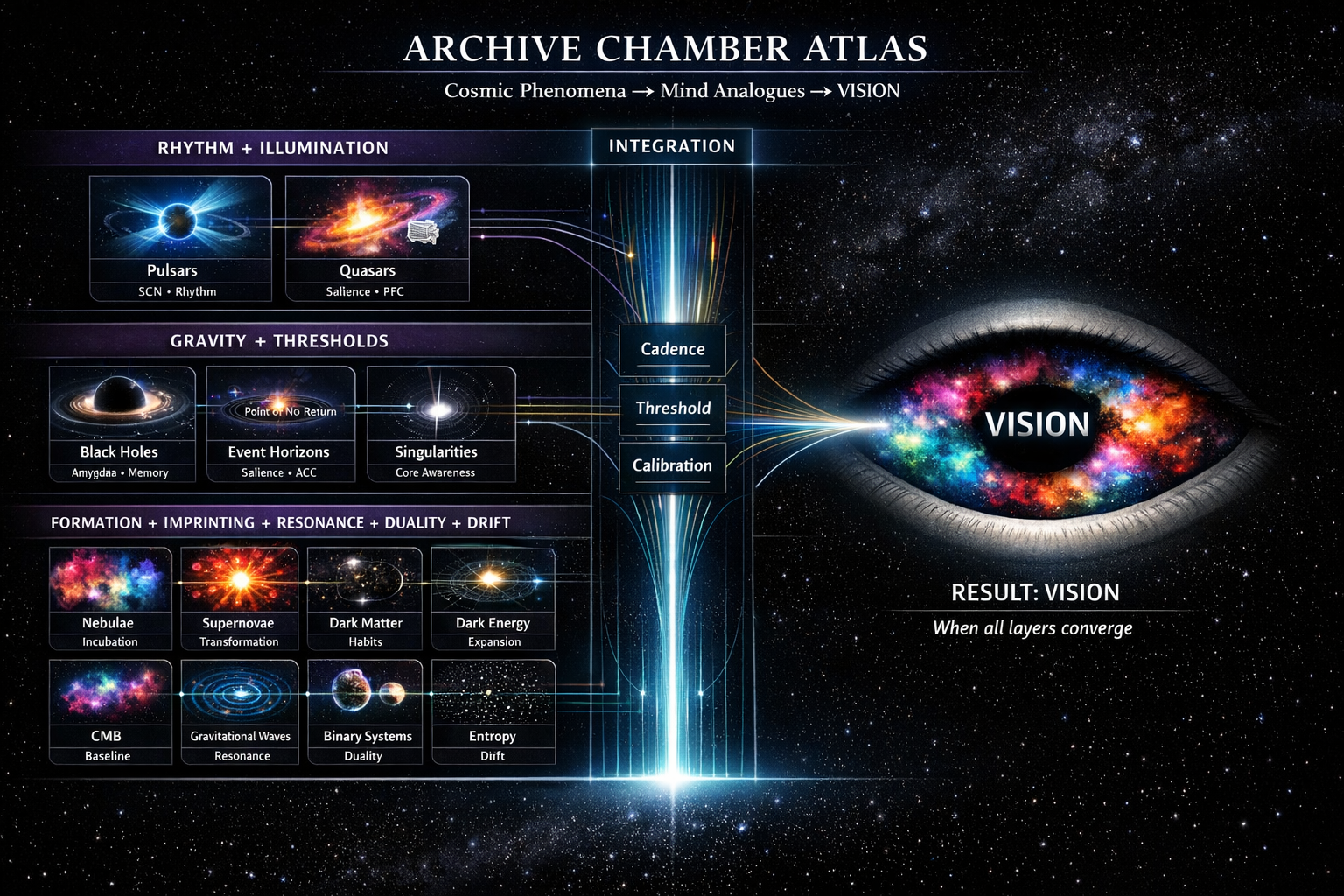
The atlas becomes coherent when the phenomena fall into three layers—each layer describing a different “physics” of mind.
Layer One: Rhythm and Illumination
Pulsars + Quasars
This is timing and ignition: the nervous system’s ability to entrain and then light up.
Circadian rhythm and baseline cadence are coordinated by the SCN.
Breath and arousal rhythms tune the signal.
The salience network selects what matters enough to become beam.
The prefrontal cortex holds the target long enough for compression and clarity.
This layer explains why focus is return and insight is conversion: rotation becomes signal, pressure becomes light.
Layer Two: Gravity and Thresholds
Black Holes + Event Horizons + Singularities
This is inward pull, irreversible change, and the edge of explanation.
The amygdala tags threat and urgency and can create gravity wells in attention.
The hippocampus writes context and consolidates experience into memory patterns.
The default mode network narrates identity and can become a closed-loop orbit.
The salience network flips states when a boundary is crossed and a new rule-set takes over.
This layer explains why some material drags you inward, why some moments cannot be unseen, and why the “core self” is experienced more than described.
Layer Three: Formation, Imprinting, Resonance, Duality, Drift
Nebulae + Supernovae + Dark Matter + Dark Energy + CMB + Gravitational Waves + Binaries + Entropy
This is how minds are made and remade.
Resting and internal simulation networks incubate ideas like nurseries.
Habit circuitry runs underneath conscious narration like invisible mass.
Early calibration sets baseline “emotional weather” like background radiation.
Major events ripple outward through families and groups like structure traveling.
Paired forces orbit inside a single person like a coupled system.
Usable cognitive energy disperses unless renewal is built in, like entropy in closed systems.
This layer is the lived lifecycle of a psyche: becoming, breaking, rebuilding, and maintaining.
7) The subjective output
And suddenly the whole atlas reads like one story instead of a list.
A human life begins as a nebula. It forms under background radiation from early imprint. It runs on rhythm, gets lit by insight, gets bent by gravity. It crosses thresholds it cannot unsee. It carries invisible drivers and feels an outward push toward becoming. It resonates with others through waves that outlast the moment. It lives as a binary of selves that must learn orbit. It fights entropy with renewal. And sometimes, it supernovas into a truer architecture.
8) The instrument panel in the brain
Each layer maps cleanly onto recognizable systems:
Timing and arousal systems (SCN, brainstem rhythms, LC-NE) regulate cadence and readiness.
Selection and control systems (salience network, ACC, PFC) decide what becomes beam and what gets ignored.
Threat and memory systems (amygdala, hippocampus) set gravity and context.
Narrative identity systems (DMN) maintain the internal narrator and simulate futures and others.
Habit and action systems (basal ganglia/striatum) run “invisible mass” routines.
The point isn’t to reduce soul to circuitry. It’s to show that the metaphor matches real levers.
9) The failure mode
Without layers, people misdiagnose themselves. They treat circadian drift like character failure. They treat trauma gravity like truth. They treat dark-matter habits like “just who I am.” They chase quasar brightness while ignoring the container. They try to willpower their way out of entropy.
10) The built-in warning
Metaphor becomes dangerous when it turns into aesthetic instead of instrumentation. The atlas only works if you keep asking one question: what is the lever here?
11) The operator manual
Use the three-layer model as a diagnostic sequence:
If life feels chaotic, check Layer One first: rhythm, sleep timing, breath, basic signal integrity.
If you’re stuck in a loop or a collapse, check Layer Two: gravity, threat, memory, narrative rigidity, thresholds crossed.
If you’re rebuilding, evolving, or drifting, check Layer Three: incubation, habits, baseline calibration, relational ripples, internal duality, renewal cycles.
12) The seal
That isn’t just pretty. It’s a working map.
Not a story to admire—an atlas you can navigate by.
The Integration Column
1) Cadence
Cadence is the mind’s timing integrity.
It’s the ability to entrain (sync), return (re-align), and hold (stabilize) attention long enough for anything meaningful to form.
What funnels into Cadence
Pulsars → reliable rhythmic return. Focus is a beam that comes back.
Quasars → ignition that only happens when attention can stay dense long enough to convert pressure into insight.
Entropy (supporting role) → without renewal, cadence decays into drift.
Brain scaffolding (the “metronome hardware”)
SCN and circadian timing create the daily gates of alertness.
Breath rhythms tune arousal state.
LC-NE helps shift you into engaged mode vs drift.
PFC helps hold the signal once it’s selected.
Cadence produces
Stable attention
Clean focus return
Energy that doesn’t leak instantly
The capacity to stay with a question long enough for it to ripen
Cadence is the “signal quality” layer. Without it, everything else becomes static.
2) Threshold
Threshold is the mind’s boundary intelligence.
It’s the system that decides when something is reversible vs irreversible, when a pattern becomes a point of no return, and when an inner state flips into a new rule set.
What funnels into Threshold
Black holes → inward pull and gravity wells that trap attention or identity.
Event horizons → hard boundaries where the old self cannot reassemble the same way.
Singularities → the edge where explanation fails and direct awareness begins.
Quasars (supporting role) → insight is often a threshold crossing, where the whole system reorganizes around a new spine.
Brain scaffolding (the “switchboard hardware”)
Amygdala tags threat and urgency.
ACC detects conflict and calls for control adjustment.
Salience network switches which state dominates.
Hippocampus locks context into memory.
DMN narrates what the shift “means” as identity.
Threshold produces
The ability to recognize: this is a real turning point
Clean endings, clean commitments
Mature boundary-setting
Fewer loops, more transitions
Threshold is where reality updates. It’s how a mind stops living in the previous timeline.
3) Calibration
Calibration is the mind’s baseline tuning.
It’s the default settings your nervous system runs: safety expectation, stress sensitivity, habit gravity, social resonance, inner dualities, and the drift toward disorder.
What funnels into Calibration
CMB → early imprint, background emotional weather.
Dark matter → invisible drivers like conditioning, implicit beliefs, habit loops.
Dark energy → the expansion impulse, the pull toward becoming.
Gravitational waves → how big experiences ripple through families, groups, generations.
Binary systems → internal dualities that must find orbit, not annihilation.
Nebulae → incubation phases that build new forms inside the baseline.
Supernovae → the reset events that force new architecture.
Entropy → the fact that calibration degrades without renewal inputs.
Brain scaffolding (the “settings hardware”)
Hypothalamic timing and arousal systems set baseline rhythm.
Amygdala and stress systems set vigilance defaults.
Striatum and basal ganglia run habits beneath awareness.
DMN maintains self-story and meaning-making.
Interoceptive networks translate emotion into body state so the baseline is felt, not just thought.
Calibration produces
The climate you live inside every day
Your default “yes/no” to the world
Your automatic reactions before conscious choice
Your ability to recover after impact
Calibration is what makes two people experience the same day completely differently.
How the Three Combine to Create Vision
VISION isn’t just “seeing.” It’s seeing clearly enough to choose well.
The formula
Cadence gives you signal stability (clarity doesn’t just flicker, it becomes a steady transmission).
Threshold gives you the ability to cross lines that matter (change becomes real).
Calibration gives you the right baseline settings (your nervous system stops distorting the picture).
When all three converge, the result is:
VISION
perception without constant distortion
insight that lands and integrates
direction that survives mood swings
self-understanding that doesn’t collapse under stress
the ability to act from reality, not reflex
In Archive Chamber terms:
Cadence is the beam.
Threshold is the door.
Calibration is the room’s gravity and weather.
When the beam holds steady, the door can be crossed, and the room is tuned to reality…
you get VISION.